
Keyword Extractor vs Keyword Generator: Which Do You Need?
Introduction
If you work in SEO, content marketing, or digital publishing, you’ve probably seen tools labeled “keyword extractor” and “keyword generator.”
At first glance, they seem similar. Both deal with keywords. Both promise SEO growth.
But here’s the truth most beginners miss:
A keyword extractor and a keyword generator solve two completely different SEO problems.
Choosing the wrong one can waste time, hurt rankings, and confuse your content strategy.
In this guide, I’ll break down the difference clearly, share real-world use cases, and help you decide which tool you actually need—or if you need both.
What Is a Keyword Extractor?
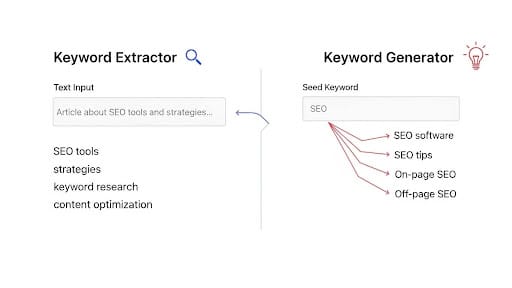
A keyword extractor pulls relevant keywords from existing content.
That content could be:
- An article or blog post
- A PDF or research paper
- A competitor’s webpage (via URL)
- Product descriptions
- News articles
Instead of guessing keywords, the tool analyzes what already exists and extracts:
- Core topics
- Contextual phrases
- Long-tail keywords
- Entities and related terms
This approach aligns closely with semantic SEO and Google’s understanding of content meaning.
Internal link suggestion:
👉 Free AI Keyword Extractor Tool → https://sszconnect.com/ai-keyword-extractor-tool/
What Is a Keyword Generator?
A keyword generator works the opposite way.
Instead of analyzing content, it creates keyword ideas from a seed term.
For example, if you enter:
“digital marketing”
A keyword generator might suggest:
- digital marketing services
- digital marketing for small businesses
- digital marketing strategy 2025
- digital marketing course online
These tools usually rely on:
- Search volume databases
- Google autocomplete
- Trend modeling
- Historical keyword data
They are widely used for topic discovery and planning new content.
Keyword Extractor vs Keyword Generator (Core Difference)
Here’s the simplest way to understand it:
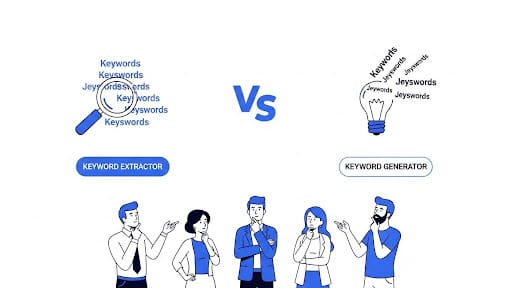
- Keyword Extractor = Analyze what exists
- Keyword Generator = Imagine what could rank
Both are useful—but at different stages of SEO.

Side-by-Side Comparison
Feature | Keyword Extractor | Keyword Generator |
Input | Text, document, or URL | Seed keyword |
Output | Contextual, real keywords | Suggested keyword ideas |
Focus | Meaning & relevance | Search demand |
Best for | Optimization, audits | Planning, ideation |
SEO Style | Semantic SEO | Traditional + modern SEO |
Accuracy | High (content-based) | Varies (data-based) |
When You Should Use a Keyword Extractor
A keyword extractor is ideal when you already have content in front of you.
Common Use Cases
- Optimizing an existing blog post
- Analyzing a competitor’s article
- Extracting keywords from research papers
- Improving on-page SEO without rewriting everything
- Building topic clusters from long content
For example, bloggers often use a keyword extractor to:
- Find missing semantic keywords
- Improve internal linking
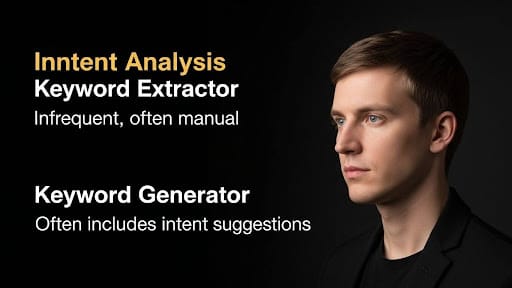
- Align content with search intent
 How to Extract Keywords from an Article for SEO
When You Should Use a Keyword Generator
Keyword generators shine when you’re starting from zero.
Best Situations
- Planning new blog topics
- Finding long-tail keyword opportunities
- Creating content calendars
- Running niche research for new websites
- Discovering buyer-intent keywords
Affiliate marketers and eCommerce teams rely heavily on generators to identify:
- Product comparison keywords
- Transactional phrases
- Seasonal search terms
The SEO Mistake Most People Make
Many beginners rely only on keyword generators.
They:
- Pick high-volume keywords
- Write content
- Publish
- Wonder why it doesn’t rank
Why?
Because volume alone doesn’t guarantee relevance.
Google now prioritizes:
- Context
- Topical coverage
- Semantic relationships
That’s where keyword extractors quietly outperform.
The Smart SEO Workflow (Best Practice)
Experienced SEOs don’t choose one.
They combine both tools.
Step-by-Step Workflow
- Use a keyword generator to find topic ideas
- Write or collect content
- Use a keyword extractor to refine and optimize
- Add missing semantic terms
- Improve internal linking
- Publish or update
This hybrid approach works especially well for:
- Long-form blogs
- Authority sites
- AI-assisted writing
- Content refresh projects
Keyword Extractor vs Keyword Generator for AI SEO
With AI content tools everywhere, keyword extraction has become even more important.
AI writers often:
- Miss subtle entities
- Overuse primary keywords
- Ignore natural language patterns
A keyword extractor helps:
- Balance keyword usage
- Reduce keyword stuffing
- Improve readability
- Align content with NLP-based search
This is why modern SEO plugins and SaaS tools increasingly focus on extraction rather than generation.
Which Tool Is Better for Beginners?
It depends on your goal:
- If you’re planning content → keyword generator
- If you’re optimizing content → keyword extractor
For students, bloggers, and freelancers, starting with a free AI keyword extractor is often more practical because it teaches how real content is structured.
Which Tool Is Better for Businesses?
For agencies and businesses:
- Keyword generators help with market research
- Keyword extractors help with content performance
Most professional teams use both—often inside the same workflow.
Quick Decision Guide
Choose a keyword extractor if you want to:
- Improve rankings of existing content
- Analyze competitors quickly
- Extract keywords from URLs, PDFs, or articles
Choose a keyword generator if you want to:
- Find new content ideas
- Research niches
- Target new markets
Choose both if you want long-term SEO growth.
Try a Free Keyword Extractor
If you want to see how keyword extraction works in real time, try a tool that analyzes actual content, not guesses.
Free AI Keyword Extractor Tool
https://sszconnect.com/ai-keyword-extractor-tool/
It helps you:
- Extract keywords from text or URLs
- Find semantic and long-tail terms
- Improve SEO naturally
Conclusion
The debate between keyword extractor vs keyword generator isn’t about which tool is better.
It’s about when and why you use each one.
Generators help you plan.
Extractors help you rank.
If you understand that difference, you’re already ahead of most beginners—and much closer to SEO results that actually last.
FAQs
1. What is a keyword extractor?
A keyword generator creates new keyword ideas based on a seed word, usually using search trends, suggestions, and user queries.
2. What is a keyword generator?
A keyword generator creates new keyword ideas based on a seed word, usually using search trends, suggestions, and user queries.
3. What is the main difference between a keyword extractor and a keyword generator?
A keyword extractor analyzes existing content, while a keyword generator helps discover new keyword ideas before content creation.
4. Which tool is better for SEO content optimization?
A keyword extractor is better for optimizing existing articles, blogs, and competitor pages for SEO relevance.
5. When should I use a keyword generator instead?
Use a keyword generator when you are planning new content and need topic ideas, long-tail keywords, or niche opportunities.
6. Can I use both tools together?
Yes. Many SEO professionals generate keywords first, then use a keyword extractor to optimize the final content.
7. Is a keyword extractor useful for competitor analysis?
Absolutely. Extracting keywords from competitor URLs helps identify ranking terms and content gaps quickly.
8. Do keyword extractors work better with AI?
AI-powered keyword extractors are more accurate because they understand context, search intent, and semantic relationships.
9. Which tool is better for bloggers and content writers?
Bloggers benefit more from keyword extractors when updating or improving content, while generators help during topic research.
10. Which one should beginners choose?
Beginners should start with a keyword extractor because it’s easier to use and improves existing content without deep SEO knowledge.
Купить пластиковые окна на заказ в Москве — это отличный способ улучшить энергоэффективность вашего дома и повысить его комфорт.
Уход за такими окнами минимален, что позволяет сосредоточиться на других задачах.
Alright, blue100novibet, just gave you a whirl. Site’s snappy and the games are pretty sweet. Hope my luck holds out! Check it out blue100novibet.